


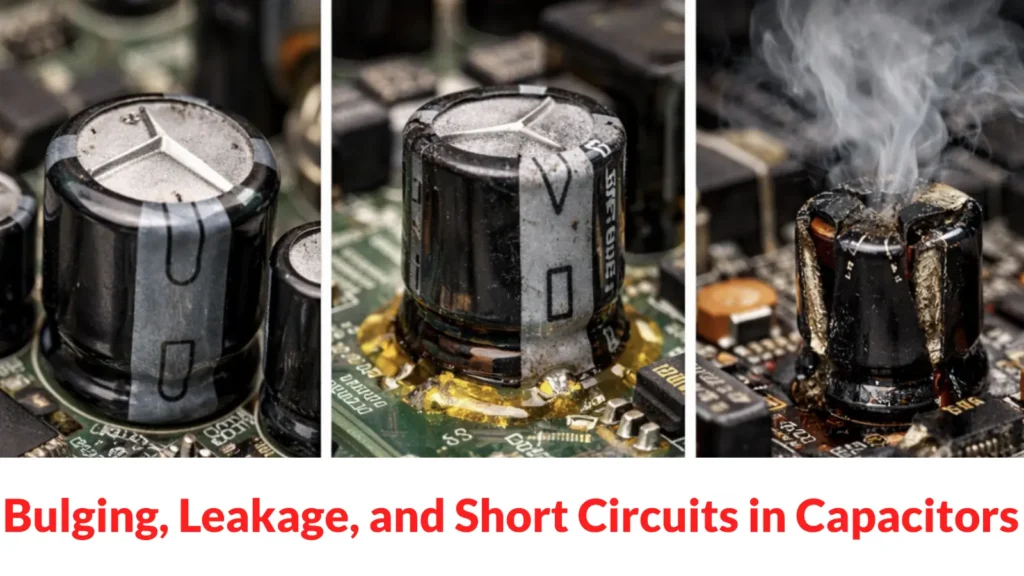
Capacitors are essential components in electronic systems. They are widely used in PCB assemblies, household appliances, industrial control equipment, and new energy products, where they support filtering, coupling, voltage stabilization, and energy storage. But in real-world use, capacitor failures are common. Among all failure modes, bulging, leakage, and short circuits are the three problems seen most often.
In mild cases, a failed capacitor may only cause unstable performance or reduced efficiency. In more serious cases, it can damage the PCB, destroy surrounding components, or even create a fire risk. Many people simply replace the failed part and move on, without identifying the real cause. As a result, the same problem often returns.
In reality, capacitor failures are rarely random. They are usually caused by a combination of electrical stress, temperature, assembly quality, environmental conditions, and incorrect component selection. This article breaks down the root causes behind these three common failures and explains how to prevent them.
Before looking at each failure mode, one point is worth making clear: most bulging and leakage problems are associated with electrolytic capacitors, especially aluminum electrolytics, because their reliability depends heavily on the condition of the electrolyte. Short circuits, however, can occur in several capacitor types, including electrolytic capacitors and multilayer ceramic capacitors used as SMD components in modern electronics.
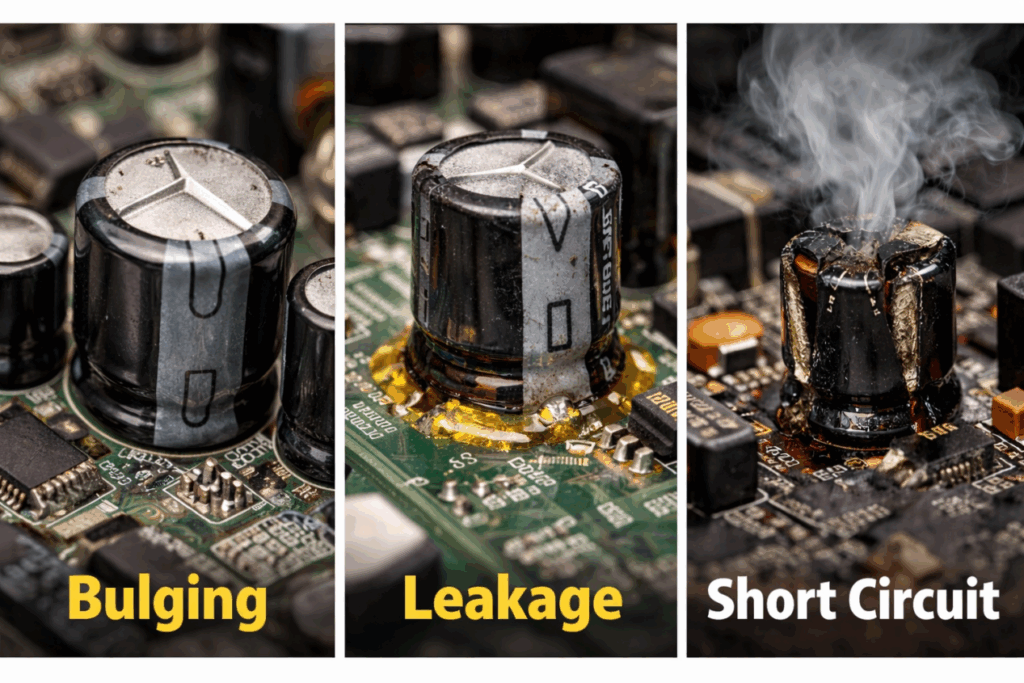
Table of Contents
Bulging: The Most Visible Failure Mode
Performance
Bulging is one of the easiest capacitor failures to identify. The top or side of the capacitor swells outward, and in some cases the pressure relief vent opens or ruptures. This is most common in liquid aluminum electrolytic capacitors. Solid polymer capacitors are less likely to bulge in the same way, but they can still fail under severe electrical or thermal stress.
The direct cause of bulging is excessive internal gas generation. When gas builds up faster than it can be safely relieved, pressure inside the can rises until the casing deforms.
Overvoltage
Every capacitor has a rated voltage. If the applied voltage remains above that rating for long periods, the dielectric and electrolyte can degrade, producing gas inside the capacitor. Overvoltage is a well-known cause of failure in aluminum electrolytic capacitors.
A typical example is a power board in a router or set-top box. If the adapter output is unstable or the design margin is too small, the filter capacitors may operate under repeated overvoltage stress and begin to bulge after extended service.
High Temperature Aging
Temperature has a major impact on electrolytic capacitor life. In general, lifetime decreases as operating temperature rises, and a commonly used rule of thumb is that every 10°C increase roughly halves expected life for aluminum electrolytics.
That is why capacitors located near CPUs, GPUs, power semiconductors, or heat sinks often fail earlier than expected. Poor airflow, dust buildup, and low-quality components can make the problem worse.
Excessive Ripple Current
Ripple current generates internal heating due to ESR losses. If the ripple current exceeds the capacitor’s rating, the part heats up from the inside, accelerating electrolyte breakdown and gas formation. This is especially common in power supplies and industrial control boards.
In many cases, the root cause is not the capacitor alone, but poor design selection. A capacitor with insufficient ripple-current capability may work at first, then fail prematurely after long-term thermal stress.
Reverse Polarity
Polarized capacitors, such as aluminum electrolytic and tantalum capacitors, must be installed with the correct polarity. Reverse voltage can quickly damage the dielectric, create high leakage current, and lead to venting, bulging, or catastrophic failure.
This often happens during repair work, prototype assembly, or manual soldering when the polarity marks are misread.
Component Quality Problems
Low-cost or counterfeit capacitors may use poor electrolyte systems, weak sealing materials, or inconsistent manufacturing processes. Even under normal voltage and temperature conditions, these parts can age early and fail far sooner than expected.
Leakage: A Warning Sign That Should Not Be Ignored
Performance
Electrolyte leakage is often the next stage after bulging, although it can also appear without dramatic swelling. It usually shows up as a yellow, brown, or dark residue around the base or vent area of the capacitor. In severe cases, leaked electrolyte can corrode pads, traces, and nearby metal surfaces.
The main reason for leakage is seal failure. Once the sealing system is compromised, electrolyte escapes from the capacitor body.
Leakage After Bulging
In many cases, leakage is simply the follow-up stage of bulging. As internal pressure rises, the vent or seal weakens. Once that structure cracks or opens, the electrolyte begins to seep out.
If you find a leaking electrolytic capacitor, the internal chemistry has already been compromised. Cleaning the outside does not restore the part.
Poor Sealing Quality
Capacitor sealing quality is critical to long-term reliability. If the seal between the can, terminal area, or vent is poorly made, electrolyte can slowly escape during service. Lower-end consumer products often show this problem earlier because of aggressive cost reduction.
Rapid Temperature Cycling
Outdoor electronics, automotive systems, and other equipment exposed to repeated hot-cold cycling place mechanical stress on capacitor seals. Thermal expansion and contraction can gradually create gaps in the sealing structure, especially over long service periods.
Mechanical Damage
Impact, vibration, or excessive force during installation can damage the casing or leads and weaken the seal. This can happen during shipping, maintenance, or poor handling in SMT assembly and post-assembly operations.
Short Circuits: The Most Dangerous Failure Mode
Performance
A shorted capacitor is usually the most serious failure because it can draw very high current instantly. This may blow a fuse, damage a power IC, burn a trace, or in extreme cases produce smoke or ignition.
The direct cause is the breakdown of insulation between the two electrodes. That can happen for several different reasons.
Dielectric Breakdown from Overvoltage
If the applied voltage greatly exceeds the rated voltage, the dielectric can break down and create a direct conductive path. In electrolytic capacitors, this often means oxide-layer failure. In power systems, this can happen during line surges, adapter faults, or regulator failures.
Electrolyte Degradation or Contamination
When electrolyte chemistry degrades because of heat, overvoltage, age, or contamination, insulation performance can fall sharply. In severe cases, conductive paths form inside the capacitor. External contamination such as moisture can also accelerate failure in damaged parts.
Reverse Polarity
Reverse polarity is especially dangerous in polarized capacitors. It can cause rapid dielectric failure, very high current, heating, venting, and in some cases a direct short. Manufacturer guidelines explicitly warn against reverse voltage and AC application on polarized electrolytic and polymer capacitors.
Mechanical Damage
Mechanical stress can also create short circuits, especially in ceramic capacitors. Board flexing, mishandling, or excessive soldering stress can crack an MLCC. Once a crack propagates through the ceramic body, it may eventually bridge opposing electrodes and create a low-resistance short. This is a well-documented failure mode in multilayer ceramic capacitors.
Wrong Capacitor Selection
Incorrect part selection can create a long-term reliability problem even if the board passes initial testing. For example, using a capacitor that cannot handle the required ripple current, frequency, voltage margin, or thermal environment can cause gradual internal damage that ends in a short circuit.
Common Root Causes and Practical Prevention Tips
Looking across all three failure modes, the main shared causes are easy to see: overvoltage, excessive temperature, poor part selection, weak assembly practices, and poor component quality.
Here are four practical ways to reduce capacitor failures in real products:
Choose the Right Part for the Real Operating Conditions
The capacitor should be selected based on actual working voltage, ripple current, temperature, frequency, and service life requirements. As a general design practice, engineers often leave voltage margin above the normal operating voltage rather than choosing a part right at the limit. For power applications, ripple-current capability is just as important as capacitance value.
Control Temperature
Keep capacitors away from major heat sources whenever possible. Improve airflow, reduce dust buildup, and use higher-temperature-rated parts in automotive, outdoor, or industrial equipment. For aluminum electrolytics, lower operating temperature has a major effect on service life.
Improve Installation and Assembly Quality
Pay close attention to polarity, soldering temperature, dwell time, and mechanical support. During SMT assembly, board flex, pick-and-place stress, and rework practices should be controlled carefully, especially for ceramic chips and other sensitive SMD parts.
Use Qualified, Traceable Components
Do not rely on low-cost unknown parts for critical products. Established brands and authorized distribution channels reduce the risk of poor sealing, unstable electrolyte chemistry, and counterfeit components.
Common Misunderstandings
Misunderstanding 1: A Bulging Capacitor Can Still Be Used
It should be replaced immediately. Bulging means the internal condition has already become unstable, and continued use can lead to leakage, short circuit, or vent rupture.
Misunderstanding 2: A Leaking Capacitor Can Be Cleaned and Reused
No. Once electrolyte has escaped, both the capacitor and the surrounding PCB may already be damaged. The part should be replaced, and the board should be inspected for corrosion.
Misunderstanding 3: A Shorted Capacitor Is Always the Capacitor’s Fault
Not necessarily. A capacitor may short because of a deeper circuit issue such as regulator failure, surge events, reverse voltage, or a design error. Replacing the capacitor without checking the surrounding circuit can lead to repeated failure.
Misunderstanding 4: Solid Capacitors Never Fail
Solid capacitors are generally more resistant to leakage-related failure than liquid electrolytics, but they are not failure-proof. Overvoltage, reverse bias, thermal stress, and overstress conditions can still damage them.
Final Thoughts
Bulging, leakage, and short circuits may look like simple capacitor problems, but they usually point to deeper issues involving circuit design, operating environment, assembly quality, or component selection. Replacing the failed part without finding the root cause often leads to repeat failures and larger system damage.
In practice, prevention matters far more than repair. If you control voltage stress, manage heat, choose the right capacitor for the application, and maintain good assembly quality, you can reduce capacitor failures significantly and improve overall system reliability.
Whether you are a PCB design engineer, a maintenance technician, or a product manufacturer, understanding these failure mechanisms helps you diagnose problems faster and build more durable electronics. And when it comes time to source replacement parts or qualify components for a new design, it is best to buy from a professional component sourcing partner that can provide traceable, specification-compliant parts from reliable brands rather than relying on unknown supply channels.

